
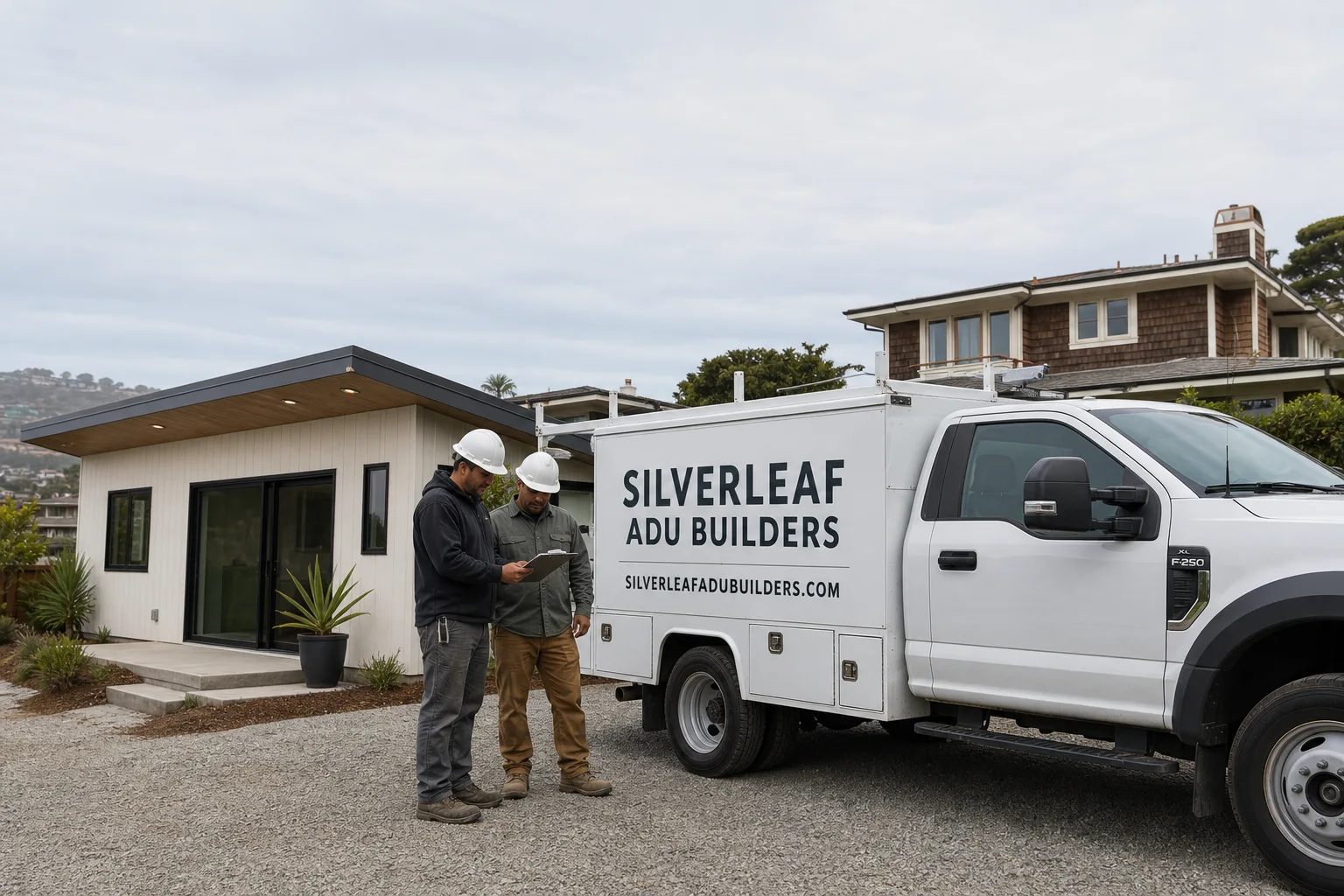
Fast, Reliable ADU Builders Across Lakeland Village
Most ADU projects in Lakeland Village stall before the first wall goes up, and the reason is rarely the floor plan. It’s the site. Steep lots off Grand Avenue, wildfire hardening requirements, septic systems sized for a 1960s cabin, and a permitting path that runs through Riverside County and Cal Fire, not a local city counter. Our ADU Builders team has worked through enough of these to know where the real costs hide and where they don’t. If you’re weighing a detached unit on a hillside lot or a garage conversion near the lake, call (833) 404-5214. We’ll tell you what’s feasible before you spend a dollar on design.
Why Silverleaf ADU Builders Is Lakeland Village’s Preferred ADU Builders Company
We treat Lakeland Village as its own job site, not a suburb of Lake Elsinore. That matters here because the constraints are different: unincorporated county jurisdiction, high fire-severity zoning, private wells and septic tanks, and sloped lots that a flatland builder never thinks about. Homeowners in 92530 tell us the same story, which is that three other contractors gave them three different answers about whether a detached ADU was even allowed on their parcel. We start with the actual code path: Riverside County fire clearance, Cal Fire review where triggered, and a site check on access before anyone draws elevations you can’t build.
Colin Steadman leads our team, and his approach is to match the build method to the lot, not the other way around. If a panelized system fits a constrained hillside, we’ll say so. If a site-built unit makes more sense because the site won’t take a crane, we’ll say that too. We’re brand-agnostic, which means our only interest is the right answer for your parcel off Ortega Highway or a quiet street near the lake. Our Lakeland Village customers tend to appreciate that we don’t pitch one prefab product and call it a day.
ADU Contractor in Lakeland Village
An ADU Contractor in Lakeland Village does far more than frame a box in a backyard. The job starts with a site reality check: can a fire engine reach a rear unit, is the septic system sized for a second dwelling, and what does Riverside County require for defensible space. We handle that evaluation, then manage the full build from foundation through final inspection. A typical detached ADU here runs $180,000 to $320,000 depending on slope, access, and the condition of existing utilities. Garage conversions run lower, usually $120,000 to $190,000, but older garages in Lakeland Village often hide electrical and foundation issues that push the number up once walls are opened.
Sloped Lot Access and Fire Clearance
Many Lakeland Village parcels slope hard away from Grand Avenue, and a rear ADU can sit 150 feet or more from the road. Riverside County fire code requires 20 feet of unobstructed width for engine access, and on a steep grade that requirement alone can dictate where the unit goes, how big it can be, and whether you need a turnaround. We map this before design starts so the plan you approve is a plan the fire marshal will sign.
Cal Fire review applies in this state-responsibility zone, which means ember-resistant vents, tempered glass on the fire-exposed side, and noncombustible or ignition-resistant cladding. We specify James Hardie fiber-cement siding as standard on Lakeland Village exteriors because it holds up to Santa Ana wind conditions and passes fire-review standards that vinyl won’t.
Septic and Well Verification
Roughly half of the lots we see in 92530 are on septic with private wells, and an ADU adds a bedroom that the existing system was never sized for. We bring in a septic evaluator before the permit is pulled. If the tank and leach field can’t take the load, you either right-size the system or shrink the unit. That conversation is better had at the start than at final inspection.
Water supply is the quieter issue. A well that produces 3 gallons a minute is enough for a cabin, but add a full bathroom and kitchen in a detached ADU and you’re now asking for 5 or more. We verify flow and storage capacity up front, then design around what the site actually gives you.
ADU Design in Lakeland Village
ADU Design in Lakeland Village is constrained by things a catalog never shows: panoramic fire-code setbacks, slopes that make a 12-foot-wide access road impossible, and the unincorporated-county reality that Riverside County reviewers will hold the plan to a stricter standard than most city plan checkers. Good design here is not picking a pretty elevation. It’s making the unit fit a lot that was platted sixty years ago with no thought of a second dwelling. Design fees for a Lakeland Village ADU typically run $8,000 to $15,000, and engineering adds $3,000 to $6,000 on sloped sites. We keep that work under our roof so the designer and the builder are looking at the same site at the same time.
Designing Around Fire Engine Access
We’ve had lots where the buildable envelope shrunk by 40 percent once fire access was drawn correctly, because the 20-foot-wide path plus turnaround radius ate the flat part of the yard. The design response is not to fight the code. It’s to shift the unit forward, change the orientation, or step down the grade with a split-level plan. A thoughtful ADU on a steep Lakeland Village lot is often a two-story unit with a small footprint, which leaves more room for the access path than a sprawling single-story would.
Ember-resistant detailing is a design decision, not an afterthought. Vents rated for wildfire zones, roof eave enclosures, and window glass specified for the fire-exposed side all have to be drawn and scheduled. We fold these into the construction documents so the Cal Fire review moves without comments.
Layouts for Older Lakeland Village Lots
The existing homes here are mid-century cabins, ranch styles, and the occasional mobile on a permanent foundation. Many were built before modern setback codes, which means the ADU often has to thread a narrow gap between the main house and the property line. We design compact footprints with one-bedroom and studio plans in the 400 to 700 square foot range that still meet Riverside County’s living-space minimums and fire separation rules. A 500-square-foot one-bedroom designed for a narrow side yard can work where a 750-square-foot two-bedroom simply won’t fit.
Trusted Brands We Service in Lakeland Village
We don’t lock Lakeland Village homeowners into one prefab system. We know the Abodu and Cover product lines well, have built with panelized packages where they suit the site, and we specify James Hardie fiber-cement siding on the exterior scopes we do ourselves. For detached units on flat, accessible lots, a factory-built shell can cut site time and usually lands between $160,000 and $240,000 all in. For a steep hillside parcel off Ortega Highway, a site-built frame with a stepped foundation is often the only approach that passes fire access. We keep our recommendations honest because we’re not married to any one product. A Tuff Shed conversion, for what it’s worth, rarely pencils out in Lakeland Village once you add insulation, electrical, plumbing, and fire-rated detailing; by the time it meets code, a purpose-built studio costs about the same.
Common ADU Builders Problems We See in Lakeland Village Homes
- Cloth-wrapped and aluminum wiring in older cabins: A mid-century home off Grand Avenue often still has original wiring that will not pass for an ADU electrical tie-in. We plan for a service panel upgrade and new circuits rather than discovering it after demo.
- Sloped, unstable ground under the ADU pad: Lakeland Village sits at the base of the Santa Ana Mountains, and many rear yards drop four to eight feet across the build area. Without a soils report and a stepped or engineered foundation, the unit will crack within a few seasons.
- Fire-code surprises at final inspection: Riverside County fire clearance and Cal Fire review both apply in this zone, and a plan that was never checked for engine access or ember resistance gets stalled at the last step. We pull those reviews early.
- Septic and well systems sized for one household: Adding a second dwelling on a private system frequently triggers a septic capacity replacement, which runs $15,000 to $30,000 depending on the soil. We verify before the permit is filed so that cost is in the budget, not a surprise.
Pricing for ADU Builders in Lakeland Village, CA
A detached ADU in Lakeland Village runs $180,000 to $320,000; a garage conversion runs $120,000 to $190,000. Those are realistic all-in ranges: foundation, framing, electrical, plumbing, drywall, finishes, and the permit path. What moves the number here more than anything else is the site: slope, fire-engine access, septic capacity, and the condition of the existing home’s electrical service. A flat lot near the lake with a 200-amp panel and city sewer lands at the low end. A steep hillside parcel with a 100-amp panel, private well, and a tank that needs replacing lands at the high end, sometimes higher. We write allowances for known unknowns into every Lakeland Village contract, and we never start changed work without a written, signed change order. Call (833) 404-5214 for a free estimate; we’ll walk your lot and give you a number that means something.
We Also Serve Cities Near Lakeland Village
Silverleaf works throughout the foothill communities around Lakeland Village, and we regularly take ADU projects in Trabuco Canyon, Rancho Santa Margarita, El Cerrito Corona, and Coto De Caza. Each of these areas has its own fire-zone and hillside realities, and our approach is the same: figure out the site constraints first, then design the unit.
Serving Lakeland Village, CA — Our Local Coverage Area
We’re based in the Lakeland Village area and know this community well. Use the map below to see our service coverage — if you’re nearby, we can almost certainly help.
FAQs About ADU Builders in Lakeland Village
Because the existing structure often can’t carry the new load or the new electrical demand without repair. We opened the rear wall on a mid-century cabin lot off Grand Avenue for an ADU tie-in and found cloth-wrapped wiring, water-damaged rim joists, and a failed shower pan membrane the previous owner had tiled over. We stopped work, documented all of it with photos, priced the framing, wiring, and waterproofing repair in a written change order, and got approval before framing resumed. That’s how we handle every Lakeland Village remodel: inspect before we quote, write allowances into the contract for what we can’t see, and never spend your money on changed work without a signed approval. Call (833) 404-5214 and we’ll explain what a pre-quote inspection covers.
Riverside County Planning and Building issues the permit, because Lakeland Village is unincorporated and has no city building department. But because this community sits inside a state-responsibility fire zone, a detached ADU can also require Riverside County fire clearance and a separate Cal Fire review before construction starts. We file all three paths and coordinate the comments so the plan moves through without you chasing agencies.
Often yes, but not at the size a catalog floor plan suggests. The binding constraint on those lots is usually the 20-foot-wide fire-engine access path plus the turnaround, and on a steep grade that consumes far more of the buildable area than homeowners expect. We design stepped foundations and compact two-story footprints to fit the accessible envelope, and we tell you honestly if a junior ADU inside the existing house makes more sense than a detached unit. A site walk will settle it; call (833) 404-5214 to schedule one.
It means the unit has to resist ember entry and direct flame exposure during Santa Ana wind events. In practice, that’s ember-resistant vents, tempered glass on the fire-exposed side, enclosed eaves, and ignition-resistant cladding like James Hardie fiber-cement. We specify these as standard on Lakeland Village ADU exteriors because Cal Fire review in this zone will not sign off on vinyl siding or unscreened gable vents.
Yes, and it should happen before the unit is designed. A septic system sized for a two-bedroom cabin may not handle a third bedroom and full bathroom in an ADU, and replacement can add $15,000 to $30,000. We verify tank and leach-field capacity and well flow at the very start of the project, then size the ADU to what the site supports. The alternative is designing a unit the county won’t approve at final inspection.
Written by Colin Steadman, Owner at Silverleaf ADU Builders, serving Lakeland Village and surrounding Riverside County foothill communities.